From Pandemic Pivot to £7.4 Billion Peak: Inside the UK Publishing Resilience Strategy
How a multi-year surge in digital audio and global exports successfully countered a turbulent domestic market (2020–2025).
Published: 9.&.2026 | Foto / Video: LBF
The UK publishing industry achieved its highest-ever revenue in 2025, driven by a booming global export market and an insatiable domestic appetite for digital audiobooks.
According to the newly released Publishing in 2025 report by the UK Publishers Association (PA), total industry turnover climbed to a record-breaking £7.4 billion, marking a 3% increase from the previous year. The figures solidify publishing's status as one of the crown jewels of the UK's creative economy.
International trade acts as the industry's ultimate powerhouse
While domestic sales saw steady progress, international trade proved to be a massive growth engine. The export market expanded by 4%, bringing in £4.7 billion and accounting for a massive 64% of total publishing revenues.
Across consumer, academic, and educational sectors, the three largest global markets for British books were:
The United States
Australia
Germany
"These latest export figures are a reminder of the role of publishing and the wider creative industries as cultural ambassadors for the UK. They are an important vehicle for sharing education, information, culture, and ideas globally."
Dan Conway, CEO of the Publishers Association

Audiobooks experience boom times, but print holds the crown
The way audiences consume literature is shifting rapidly. Overall digital revenues jumped 7% to £3.6 billion, spearheaded by a spectacular 10% surge in digital audiobooks, which brought in £255 million. Audiobooks now command a vital 10% share of the entire consumer publishing market.
Conway noted that in 2025, readers were "more likely to listen to a book, or to read content digitally, than ever before."
However, those writing off physical media will have to wait. Print revenue remained entirely resilient at £3.8 billion. In the consumer market specifically, print remains the undisputed king, accounting for an overwhelming 79% of total revenue.
Fiction thrives while education gets squeezed by budget constraints
Performance diverged sharply across the three main sectors of the industry:
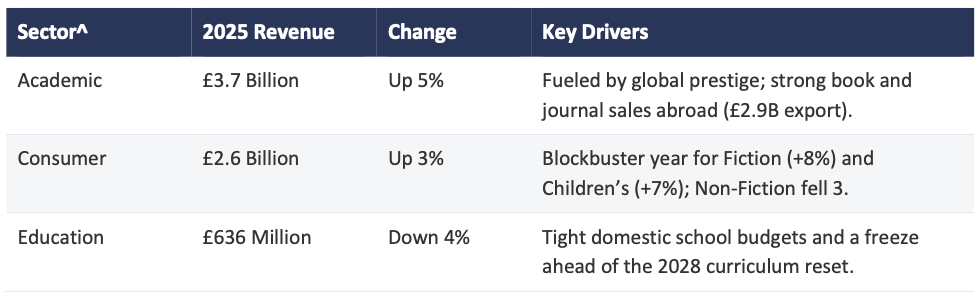
The academic market remains the largest individual sector, heavily bolstered by international reliance on UK research. Conversely, the domestic educational sector felt a punishing 13% drop. Experts attribute this domestic crunch to severe strains on school budgets and institutional hesitation to buy new materials ahead of a major UK curriculum overhaul scheduled for 2028.
The five-year trend of the UK publishing industry (2020–2024)
To fully appreciate the historic milestone of £7.4 billion achieved in 2025, it is vital to examine the five-year trajectory leading up to this point. The historical data demonstrates an industry that has remained remarkably resilient despite facing successive global disruptions, supply chain crises, and a domestic cost-of-living squeeze.
The total revenue of the UK publishing sector has followed a steady upward trajectory since 2020, experiencing only a minor stabilization phase in 2024 before breaking new ground in 2025:
2020: £6.4 billion (Pandemic onset; rapid acceleration of digital formats)
2021: £6.7 billion (+5%) (Recovery back to pre-pandemic baseline levels)
2022: £6.9 billion (+4%) (Strongly propelled by international trade)
2023: £7.1 billion (+3%) (Breaking the £7 billion threshold for the first time)
2024: £7.2 billion (+1%) (Market holding firm amid economic headwinds and high inflation)
The global shift: exports as the primary engine
A defining structural trend over the half-decade is the ever-increasing reliance on international trade. While the domestic UK market faced macroeconomic pressures, international demand consistently stepped in to absorb the shock.
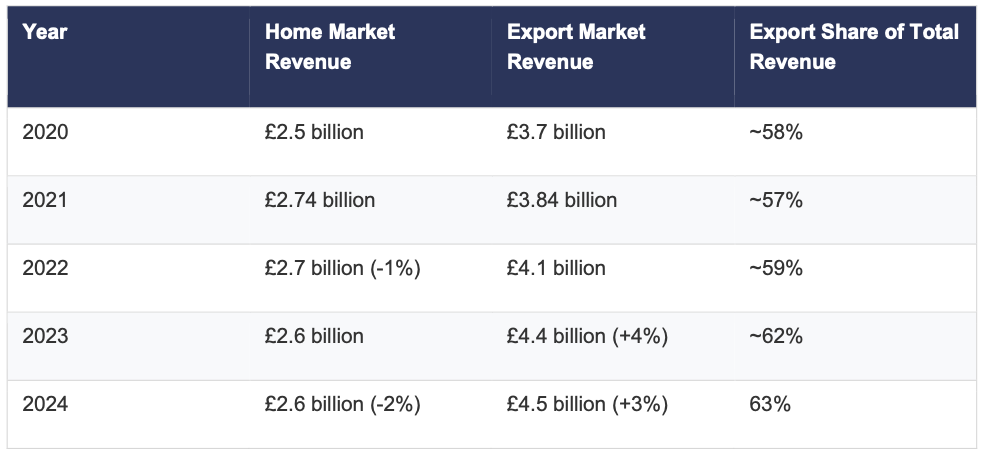
The domestic stagnation seen from 2022 onwards directly reflects the impact of the UK's cost-of-living crisis on consumer spending. This makes the industry's subsequent leap to a 64% export revenue share in 2025 the culmination of a multi-year strategic pivot toward global markets.

Format evolution: the Unstoppable rise of audio
The massive digital audiobook surge highlighted in the 2025 data is not a sudden anomaly, but the result of an incredibly steep, multi-year growth curve within the Consumer Sector:
2020: £133 million
2021: £151 million (+14%)
2022: £164 million (+8.6%)
2023: £206 million (+24%) (A historic breakout year for audio downloads)
2024: £268 million (+18%)
2025: £255 million (Consolidating at an exceptionally high, mature baseline)
Concurrently, Print remained the undisputed foundational anchor of consumer publishing, retaining a remarkably rigid market share of 78% to 79% across the entire 2020–2025 span. Physical books defied early pandemic lockdowns and retail disruptions, heavily defended by tight-knit communities and organic social media phenomena like #BookTok starting in 2021.
Sector dynamics: the chronic strain on education
The widening performance gap between the thriving Academic sector and the highly restricted Education sector was clearly visible years prior to 2025.
1. Academic (Higher Education & Research Journals)
The sector expanded solidly from £3.3 billion in 2020 to £3.5 billion in 2021/2022, hitting £3.6 billion in 2023 before a minor retraction to £3.5 billion in 2024. Throughout this entire era, the sector's rock-solid foundation was the international prestige of UK research, with digital journal exports consistently bringing in over £2 billion annually. This paved the way for the £3.7 billion peak in 2025.
2. Education (Schoolbooks & K-12 Resources)
In stark contrast, the school market faced intense systemic volatility:
2020: Dropped sharply to £528 million due to institutional pandemic closures.
2021–2022: Saw a temporary international rebound, climbing to £552 million and £634 million, heavily carried by global curriculum exports.
2023–2024: Stagnated at £661 million before dropping back down to £640 million.
The punishing 13% domestic decline felt in the home education market in 2025 is a direct prolongation of the crisis seen in 2024, where UK domestic school sales had already plummeted by 11%. This historical view proves that the current domestic school marketplace suffers from a multi-year cycle of hyper-extended budget deficits and purchasing hesitations tied directly to the upcoming 2028 national curriculum reset.
Conclusion
Integrating this historical perspective highlights the true narrative of the 2025 record: the UK publishing industry's current financial peak is not a temporary stroke of luck. It is the definitive proof of a highly successful, multi-year adaptation strategy that utilizes dominant global exports to seamlessly counter severe domestic economic turbulence.