Mature with risks
Why audiobook growth faces a reckoning despite billion-dollar revenues
The U.S. audiobook market continues to deliver solid financial results, but behind the scenes, the battle lines are shifting. While the digital format has achieved total market dominance, the industry is confronting two massive strategic challenges that threaten future profitability: an escalating piracy wave and growing consumer resistance to AI-generated narration.
Published: 9.6.2026 | Foto / Video: Magnific
Waning acceptance of AI narration
While publishers view AI-generated voices as a cost-effective tool to synthesize and monetize their backlists at scale, the public is refusing to buy in. According to Audio Publishers Association 2026 Consumer Survey, conducted by Edison Research at SSRS, consumers' openness to trying AI-narrated audiobooks actively shrank year-over-year, dropping from 70% in 2025 to 61% in 2026.
Currently, AI audiobooks represent a microscopic sliver of the market, accounting for just 0.03% of total sales revenue in 2025; only 16% of listeners have ever tried one. For publishers, this signals a clear public relations hurdle: an "AI-narrated" label currently acts as a psychological deterrent that turns core listeners off and risks damaging consumer trust.
A mature digital format still finding room to grow
New data on the U.S. audiobook market 2025
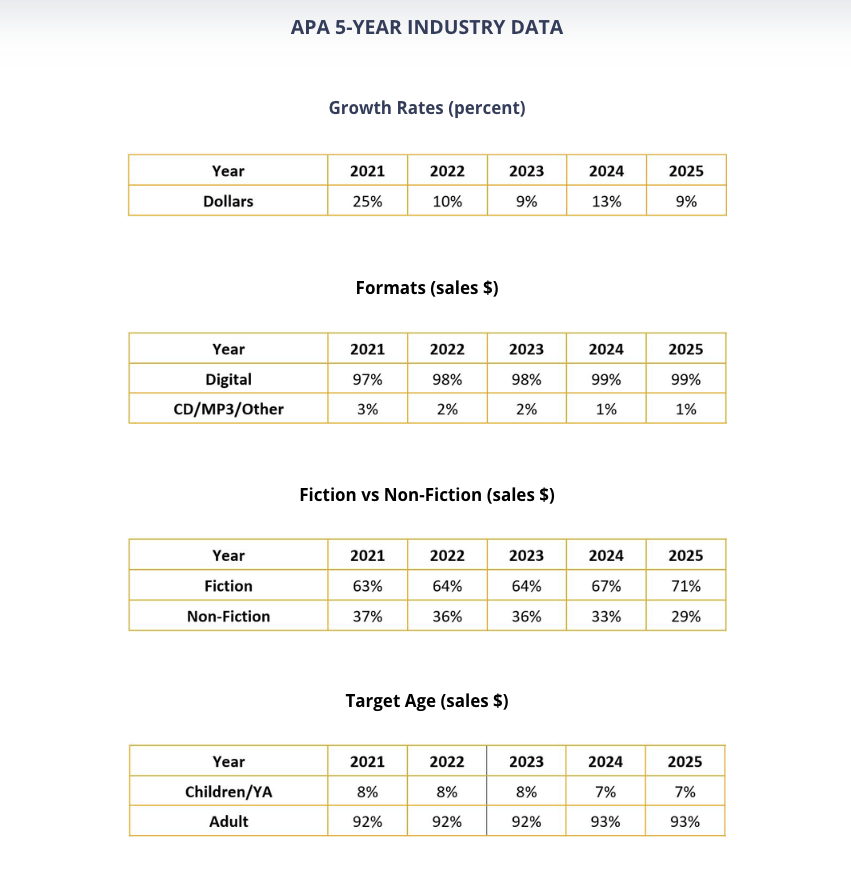
The tension surrounding AI narration highlights a sharp divide between unprecedented operational opportunities and severe systemic risks. On the corporate side, publishers view synthetic voices as a game-changing infrastructure to bridge the massive global audio gap. As Bookwire Co-CEO John Ruhrmann notes, only about 5% of published books currently exist in audio format due to the high costs of traditional studio production ($3,000 to $4,000 per title). Strategic partnerships with AI platforms like ElevenLabs allow publishers to cost-effectively monetize vast backlists, self-publishing catalogs, and niche translations for a flat monthly fee. By automating linear texts like non-fiction and business guides, AI opens vital new revenue streams and expands international rights exploitation without threatening high-end, human-narrated literary productions.
However, this commercial optimization is colliding with a profound backlash over data ethics and illegal exploitation. A major 2026 legal offensive – consisting of nine federal class-action lawsuits against tech giants like Amazon, Meta, and ElevenLabs– alleges that these companies built their multi-billion-dollar synthetic voice models by scraping proprietary audio to extract biometric "voiceprints" without consent. This creates a predatory, vertical "closed loop" where platforms like Amazon allegedly train AI engines on human master recordings from their own subsidiaries (such as Audible) to directly replace those same voice actors. Combined with deep consumer skepticism and a dropping willingness to try AI-voiced titles, this explosive combination of legal jeopardy and audience pushback threatens to derail publishers' automated scaling strategies entirely.
"The thieves and pirates who steal my work and try to profit from it, in any format, should be punished civilly and criminally... And in this particular example, YouTube is complicit because it's clear they know what is happening and refuse to stop it."
John Grisham (Photo: © Ana Murphy)

YouTube piracy as an existential threat...
The YouTube platform has inadvertently become one of the largest destinations for audiobooks—much to the dismay of rights holders. According to the APA’s 2026 consumer survey, 45% of listeners reported accessing audiobooks on YouTube, marking a drastic surge from 35% in 2024. Because YouTube does not maintain official distribution partnerships with major publishers, a vast majority of this content consists of illegal, bootlegged uploads.
The industry is now fighting back with heightened public relations and legal pressure. In a coordinated defensive move, the Association of American Publishers recently partnered with the AI-licensing and protection platform Vermillio to systematically identify and strip pirated audiobooks from the platform. APA Executive Director Jim Dinegar labeled the situation unequivocally as a "very big threat."
The proliferation of unauthorized audiobooks on YouTube marks a new front in digital piracy, driven by the same generative AI tools that have helped make audio one of publishing's fastest-growing formats. Pirates are leveraging synthetic text-to-speech software to rapidly clone new releases, meaning "A.I. versions of highly anticipated titles often appear on YouTube hours after they are released." Because most antipiracy technology is built to catch identical files rather than altered ones, these bootlegged versions – relying on changed files, added pauses, or different synthetic voices – frequently avoid detection.
Reporting by The New York Times found that these uploads leave listeners with jarring, disjointed experiences; an illegal version of John Grisham's The Widow left listeners "appalled by the emotionally flat, robotic narration and confused by the discordant videos that played in the background." The reach is significant. Data from the AI licensing and protection platform Vermillio shows that, in the month after a new bestseller is published, the company finds on average more than 5,000 individual instances of pirated AI versions across various online platforms. Those pirated editions can collectively draw "more than 200,000 streams" – meaning a substantial online audience is consuming "the audiobooks for free."
This has created a sharp conflict between major publishing houses and tech platforms over who bears the burden of enforcement. As reported by The New York Times, publishers say YouTube presents the biggest challenge – both because of its sheer scale and because, unlike platforms such as Spotify or Apple Books, it has no financial arrangement to license or sell their content. Best-selling author John Grisham leveled sharp criticism at the platform in an email to The Times, writing:
"The thieves and pirates who steal my work and try to profit from it, in any format, should be punished civilly and criminally... And in this particular example, YouTube is complicit because it's clear they know what is happening and refuse to stop it."
YouTube counters that publishers are ultimately responsible for flagging copyright infringement, but industry leaders argue that its manual takedown system is a losing battle. Ana Maria Allessi, the president and publisher of Hachette Audio, told The Times that "the current process is cumbersome, time-consuming and ultimately ineffective, as the bad actors often quickly repost under a different alias." With digital audio now accounting for more than 11 percent of publishers' overall revenue – up from 3.5 percent in 2016 – publishers are pressing for a more active partnership from the platforms, insisting that YouTube stop passively letting "illegal content proliferate" on what remains a popular, mainstream American platform.
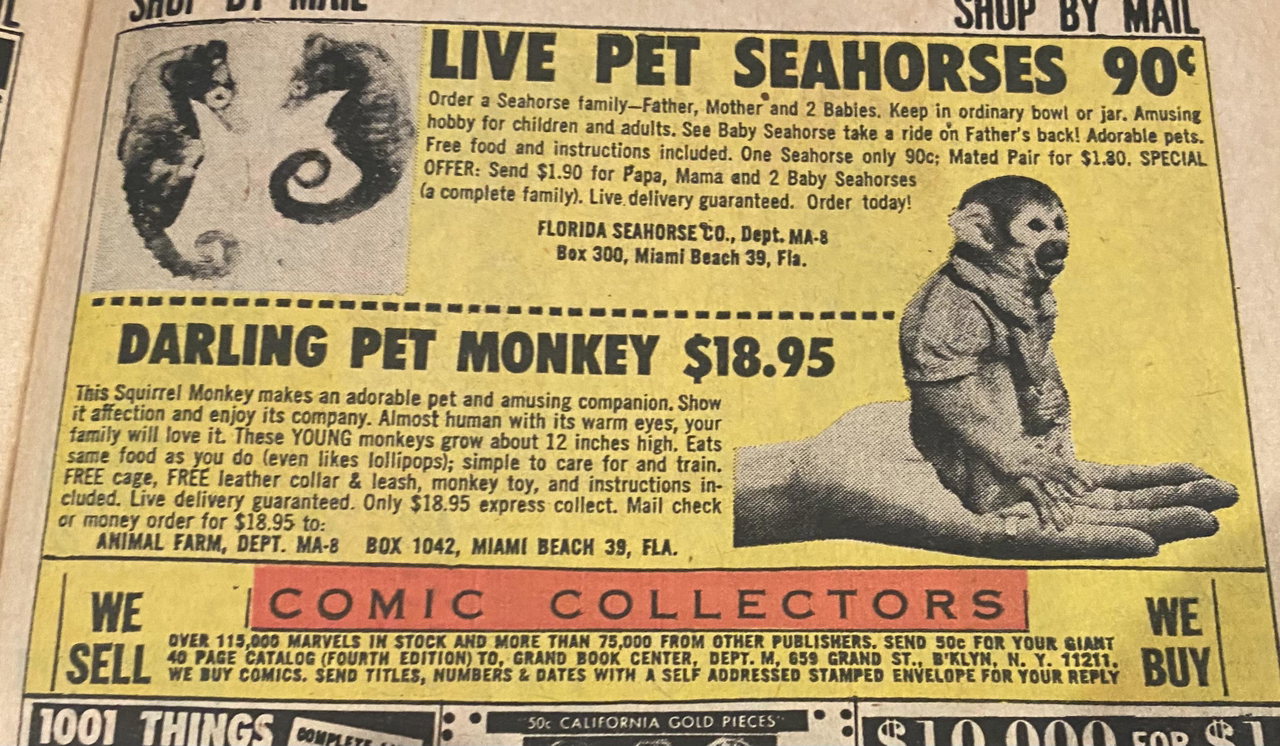
The picture shows a late-1960s ad in an old book for buying and delivering a pet monkey (via Reddit)
....or opening up a new business model for publishers
While most major publishers still do not distribute their audiobooks on YouTube, which means a share of that listening likely stems from pirated uploads, a growing number of self-published authors are deliberately releasing their fiction there alongside marketplaces such as Audible. Their motivation mirrors that of any YouTube creator: enormous reach paired with a comparatively generous revenue-sharing model. According to media analyst Simon Owens (Substack) some authors report earning thousands of dollars a month from YouTube audiobooks, and say the videos have driven additional sales of their print editions – though such accounts remain anecdotal.
Owens argues that this trend points to two underexplored implications. The first is an advertising-supported model that book publishers have largely shied away from, even as they sit on vast back catalogs of out-of-print titles that could, in principle, be released as free, ad-supported audio. The second is structural: much as YouTube drifted almost accidentally into becoming a dominant podcasting platform – without any major dedicated push, simply by letting creators upload full-length recordings – it could end up reshaping book publishing in a similar way. As, in Owens' view, the only major social platform that shares a meaningful portion of revenue with its creators, YouTube exerts a gravitational pull on new talent, gradually drawing more of the creative industries into its orbit.