From content machine to trusted brand
What media companies and publishers should take away from Benedict Evans’ latest AI analysis, ‘AI eats the world’
The technology sector undergoes a fundamental platform shift every 10 to 15 years. Following mainframes, PCs, the web and smartphones, the market in spring 2026 is centred on generative AI. Benedict Evans’ analysis “AI eats the world”, regarded as the gold standard of technology analysis, and his essay “Predicting AI job exposure” make it clear that the purely investment-driven phase of technology adoption is giving way to a phase of structural market reorganisation.
Published: 28.5.2026 | Foto / Video: KI-generiert, Magnific
For the strategic management of the entire publishing industry – from daily news media and highly specialised academic publishers to general-interest book publishers – this development requires a fundamental reassessment of business models, cost structures, job profiles and the intrinsic value of content.
A market in imbalance
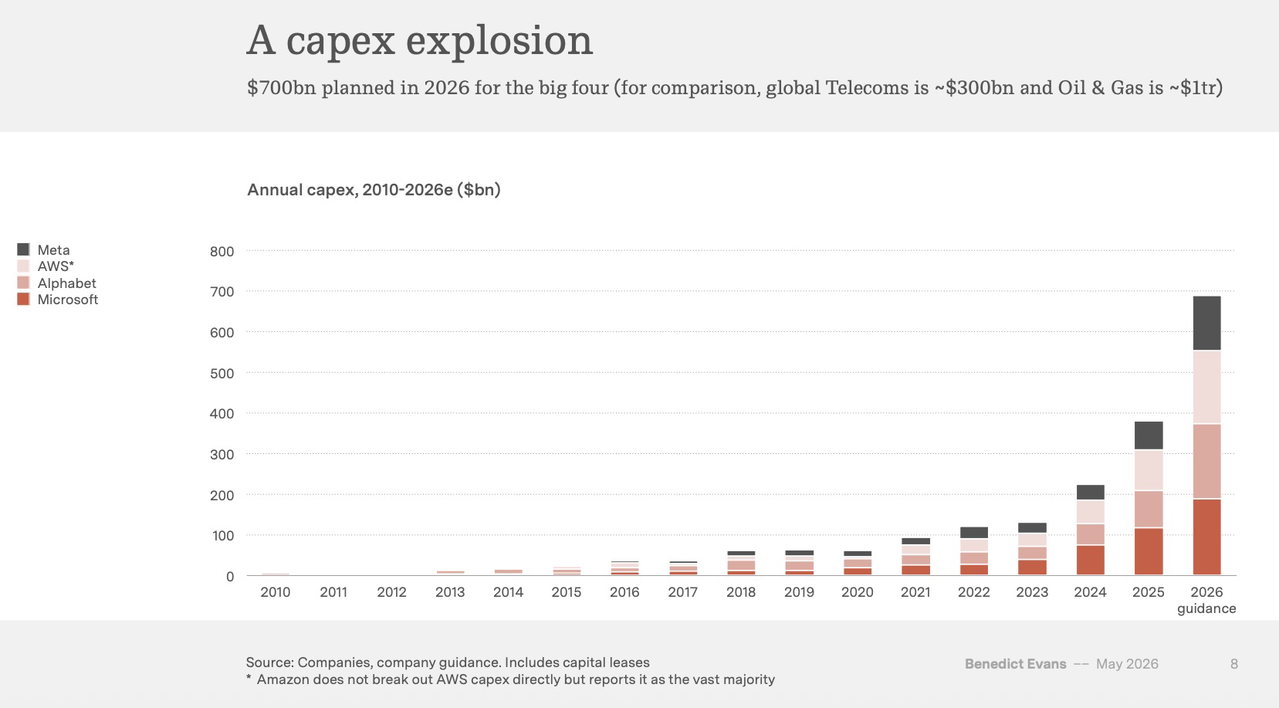
Data on the global tech infrastructure reveals an unprecedented explosion in capital expenditure. The four leading technology conglomerates are planning capital expenditure (Capex) of around 700 billion US dollars for 2026 – driven by demand that far outstrips supply, as well as the race for the next generation of frontier models.
However, structural imbalances lie behind these massive investments:
Model commoditisation: The performance of the leading large language models (LLMs) is converging rapidly. As fundamental network effects are lacking at the model level, LLMs risk becoming interchangeable commodities with shrinking margins – comparable to the development of mobile networks in the 2010s.
Shift in value creation: The text-based chat interface is proving to be an inadequate user experience (UX) for the general public. The market is therefore moving ‘up the pyramid’ – away from the raw infrastructure model towards specific applications, workflows and vertical software solutions.
Superficial market penetration: Despite high user numbers, widespread adoption is not yet firmly established. Data shows that the majority of users utilise tools such as ChatGPT only occasionally, and the transformation into a genuine, daily habit in both professional and everyday contexts is still in its infancy.
Fragile funding base: The investments mentioned now exceed the free cash flow of corporations previously considered ‘asset-light’. Funding is increasingly coming from external structures – joint ventures with private equity, debt capital and, in some cases, circular revenue relationships – which raises questions about the financial sustainability of the boom.
The historical pattern of technology adoption and the analysis paradox
For traditional sectors, Evans outlines a three-stage historical pattern of how new technologies are integrated into organisations: Absorb (making existing processes more efficient), Innovate (creating new use cases) and Disrupt (redefining markets).
At the same time, the latest analysis warns against attempts to quantify the ‘exposure’ of professions and industries using rigid data models or tables. Such attempts to model the future based on data fail, when looking back at historical technological surges, due to three factors, which are illustrated using the example of publishers:
The Jevons Paradox (price elasticity): The automation of a task rarely leads to its disappearance. The example of bookkeeping shows that, despite the introduction of calculators, mainframes, PCs and spreadsheets, the number of bookkeepers and auditors did not decline but grew in the long term – with automation being just one of several factors (new regulatory requirements also drove demand). In practice, the drastic reduction in the time and cost of an analysis leads to a manifold increase in demand for analyses. Applied to publishers, this means: if translations, proofreading or indexing become cheaper through AI, this does not necessarily lead to less work, but to a massive expansion of niche and international publication projects.
The evolution of job profiles: Job titles often remain stable, whilst the actual content of the work changes fundamentally. In our industry: editors, copyeditors or product managers in specialist publishing today perform completely different tasks than they did 30 years ago – technology is shifting the range of tasks towards strategic curation and quality assurance, rather than eliminating the profession.
The problem with explicit descriptions: Standardised job databases attempt to break down professions into logical, sequential individual steps – just as earlier expert systems sought to map human capabilities via fixed rules and failed in the process. However, a profession in publishing is a complex web of implicit knowledge, literary or specialist taste, market acumen and social interaction (e.g. the relationship with authors), which defies mechanical description.
Gell-Mann amnesia: Distinct from this is a second fallacy, which Aaron Levie (CEO of Box) describes as a variant of ‘Gell-Mann amnesia’: one is fully aware of the complexity of one’s own field, yet systematically underestimates it in other professions. A superficial examination of an AI-generated text (e.g. a generated book chapter or a structured specialist text) therefore leads to the fallacy that publishers are obsolete – and ignores the actual value creation for which customers and subscribers ultimately pay.
Specific strategic questions for publishers
If, in the medium term, artificial intelligence becomes universally available as a cost-effective utility service, the operating conditions for the entire publishing industry will change fundamentally. Evans himself makes no statements about the publishing industry; the following questions apply his analytical framework to the sector. The synthesis of both analyses yields four key questions for publishing management:
Was pure content production the real moat?
The historical parallel with the music industry or traditional newspaper distribution shows that, at the time, the internet eliminated physical distribution costs (printing, logistics, CD production). This did not necessarily change the profile of an author or music scout, but it did destroy the local monopolies and distribution barriers that had been based on them.
The consequence for book and specialist publishers: Generative AI is now reducing the marginal costs of generating standard texts, software code and summaries to near zero. A specialist publisher whose business model was based purely on compiling and structuring legal texts, medical guidelines or market reports is losing this artificial protective barrier. General interest publishers must ask themselves which genres (e.g. simple self-help guides, serialised entertainment literature) were previously protected solely because human text production was time-consuming. If the market is flooded with AI-generated content, the business model based purely on quantity will collapse.
How does the strategy respond to the phenomenon of ‘decoupling’?
A key risk of new technologies is that a core product itself may remain completely untouched by AI, yet the publisher’s economic foundation crumbles in a completely different area.
The consequence for specialist and general interest publishers: The printed book or the exclusive specialist subscription as an end product may continue to be in demand by readers in its traditional form.
However, disruption looms due to decoupling at the interfaces:
– For specialist publishers: If corporate clients feed their internal AI systems directly with raw data, the publisher’s own database or platform becomes redundant as a user interface. The business model is decoupled from the interface.
– For book publishers: The risk often lies not in editing, but in the collapse of traditional marketing and discovery channels (discoverability). If book recommendations no longer come via bookshops or reviews, but via closed AI assistants, the existing marketing infrastructure breaks down.
How is the monetisation model changing with the shift from search to synthesis?
The establishment of ‘generative search’ and AI assistants means that platforms are moving from statistical correlation (clicks on links) to an understanding of content based on fundamental principles.
The consequence for specialist media and academic publishers: universities, law firms and laboratories are increasingly no longer searching for individual specialist articles, but are having answers aggregated and synthesised directly. When specialist content is absorbed into the systems of tech giants or specialised AI workflows, traditional paywalls and licensing models based on clicks or user IDs erode. However, it should be noted that this development is still in its infancy and has so far had a supplementary and experimental effect rather than being a complete replacement. Publishers face the challenge of monetising the value of their protected data sets directly at the level of model training or via closed API interfaces, as direct end-user contact on their own platforms is declining.
How is the distinction between routine tasks and publishing value creation achieved?
It requires a strict differentiation between the technical execution of a task and the overarching objective of a job. The ‘task’ encompasses writing the text, proofreading, translation or layout. The publisher’s actual “job” consists of conveying trust, brand, curation, attitude and the discovery of genuine talent.
The consequence for the entire industry: if the web is flooded with synthetic texts, the value of the filter increases. Economic value shifts exclusively to the elements that AI cannot provide:
– In general-interest publishing: Curating a programme, building an author’s brand, creating a physical cultural artefact (high-end print) and the emotional connection to the readership (“Taste & Curation”).
– In specialist publishing: Legally binding certification, the peer-review process and the absolute accuracy of business-critical data.
Strategically, this requires a reallocation of budgets away from purely operational content creation processes towards exclusive rights, author relationships and proprietary, verified data sets.
Personal Podcasts: Spotify wants to make it easier to generate short, private, personalised audio formats directly within Spotify.
Conclusion: Operating under radical uncertainty
The most important methodological insight from historical retrospection is this: specific forecasts about the future of individual industry segments are, at this early stage, purely a matter of chance. When the internet emerged, people predicted the end of printed paper – but it was impossible to model that it would destroy the press advertising markets, whilst the printed book would experience a renaissance of the analogue in the consumer market.
For publishing management, this means discarding quantitative predictions about job losses or a linear decline in sales. The disruptive impact of AI usually occurs outside one’s own systems – through changes in the way knowledge is consumed, entertainment is sought, and work is carried out in the B2B sector.
The strategic response for press, specialist and book publishers cannot lie in producing the old product “a little faster and cheaper”. Success can only be achieved by focusing on the top of the pyramid: building closed ecosystems and offerings based on the non-automated core values of a publishing brand: relevance, taste, absolute accuracy and exclusive access to intellectual property.