Veranstalltungen
A mature digital format still finding room to grow
The U.S. audiobook market 2025: a mature digital format still finding room to grow
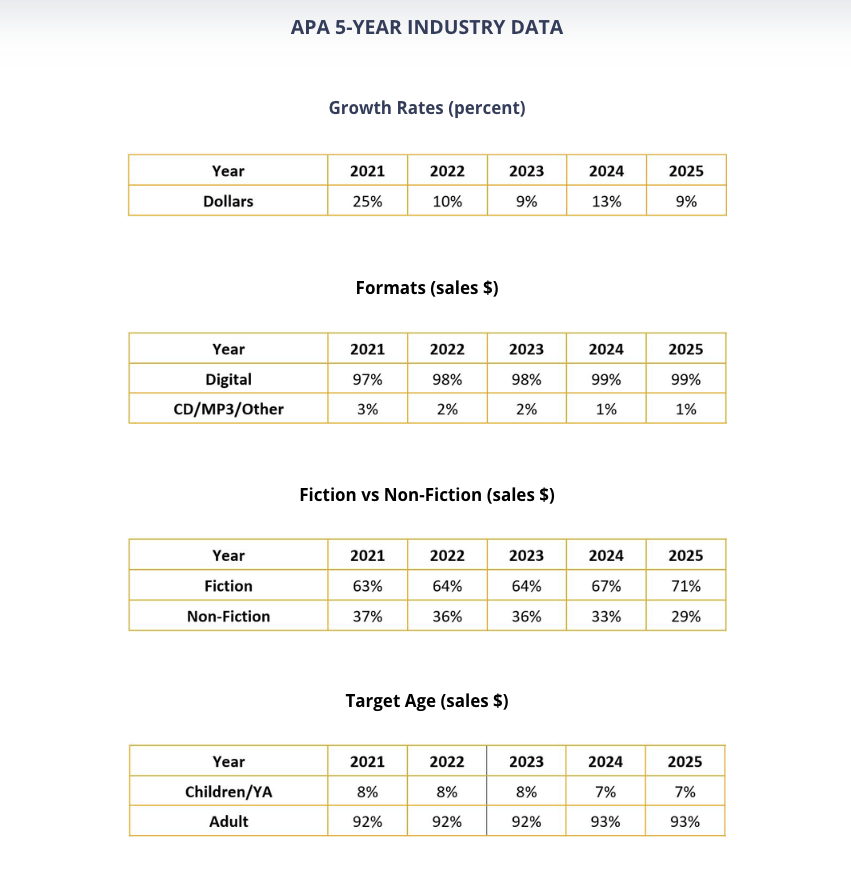
According to the Audio Publishers Association the U.S. audiobook market delivered another solid performance in 2025, but the deeper story is that growth is becoming more disciplined, entirely digital, and increasingly concentrated in fiction.
Sales rose 9% to $2.43 billion, extending a five-year run in which year-over-year gains moved from a massive 25% in 2021 to 10% in 2022, and 9% in 2023. While 2024 saw a temporary spike to 13% growth—largely driven by Spotify Technology SA shaking up the industry by introducing 15 hours of listening to its Premium subscribers—the return to 9% in 2025 points to a market that is no longer in an explosive breakout phase, but is still expanding at a highly substantial pace as the overall "pie" gets bigger.
The format transition is now effectively complete. Digital audio accounted for 97% of sales in 2021 and crawled up to an overwhelming 99% in both 2024 and 2025, while physical formats like CD and MP3 declined to just 1%. In practical terms, audiobooks are a fully digital category. Future industry growth will depend less on converting physical book buyers to digital formats, and far more on audience development, creative catalog strategy, and monetization efficiency.
Fiction has cemented itself as the clear center of gravity for the medium. Its share of sales revenue rose steadily from 63% in 2021 to 71% in 2025, while non-fiction fell from 37% to 29% over the same period. General fiction led the market in 2025, alone commanding 27% of total revenue, while science fiction/fantasy, romance, and mysteries/thrillers/suspense rounded out the top genres. This long-term shift shows that audiobook demand is increasingly driven by immersive, entertainment-led listening rather than by purely informational or educational content.
The audience base is broad, but the revenue core remains firmly adult. Adult titles held 92% of sales through 2023 and edged up to 93% in 2024 and 2025, while the total market share for children’s/YA slightly slipped from 8% to 7%. Interestingly, the fastest-growing categories in 2025 by raw dollar volume were humor, general fiction, and children’s/YA. This indicates that while children's content is expanding rapidly in its own right, the massive scale of the adult fiction market means the younger demographic's relative slice of total industry revenue remains small.
Consumer behavior reinforces this picture of a lifestyle-integrated format where convenience is the main value proposition. The APA’s 2026 consumer survey found that 58% of Americans aged 18 and older have listened to an audiobook—an estimated 157 million people—and that listeners most often cite multitasking (86%), listening on the go (84%), and screen-time substitution (70%) as the main benefits. These motivations position audiobooks alongside podcasts and streaming audio in the broader attention economy, rather than simply as a digital extension of print.
Distribution remains fragmented across several access models, giving publishers a beautifully diversified but complex ecosystem to manage. Among people who listened in the past year, many utilized multiple sources: 49% bought directly from websites or apps, 48% used subscription models, 46% borrowed through digital library apps, and 42% used credits from dedicated audiobook services. Because no single platform has fully monopolized consumer access, publishers must delicately balance retail, subscription, and library channels to maximize pricing power and discoverability.
Overall, the five-year data describe an industry that has matured beautifully without stalling. The easy gains of early digital adoption are gone, but the market is healthy, digital migration is complete, and fiction dominates the commercial core. The main question moving forward is not whether audiobooks will keep growing, but how publishers can navigate platform fragmentation, piracy pressures, and consumer pushback against AI to protect their margins.