From Doomer to Boomer
Daniel Lenz on how the industry views the future of AI – a recap of our ‘Doomer-Boomer’ campaign

Published: 29 October 2026 | Photo / Video: dpr
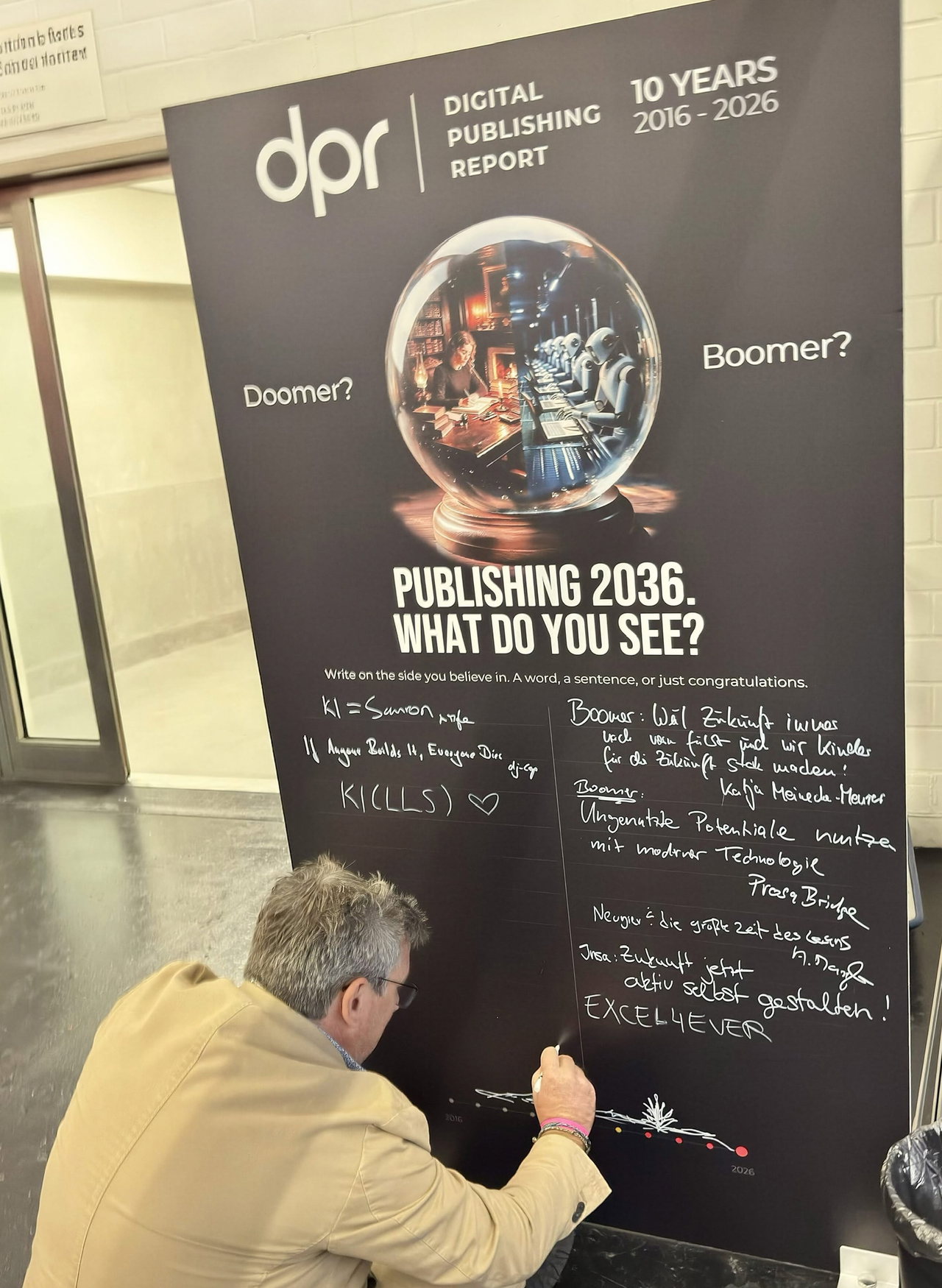
To be honest, I’d expected one page at most. To mark the tenth anniversary of the DIGITAL PUBLISHING REPORT, we developed a campaign which, with a very humorous twist, boiled down to the question: Will AI kill off publishing? At the Frankfurt Book Fair, not only at our stand but also at the events we helped organise, there was a display board: at the top, a crystal ball; inside it, on the left, an author by an open fire; on the right, a row of writing robots; and below it, the question ‘Publishing 2036. What do you see?’. Visitors could sign on the side they believed in: on the left, ‘Doomer?’ (i.e. the pessimists); on the right, ‘Boomer?’ (the technology optimists). A word, a sentence or simply a message of congratulations. In the end, the front didn’t offer enough space, so we had to open up the back – and that’s now full too. We’d like to take this opportunity to say a heartfelt thank you to everyone who picked up a pen at our board.
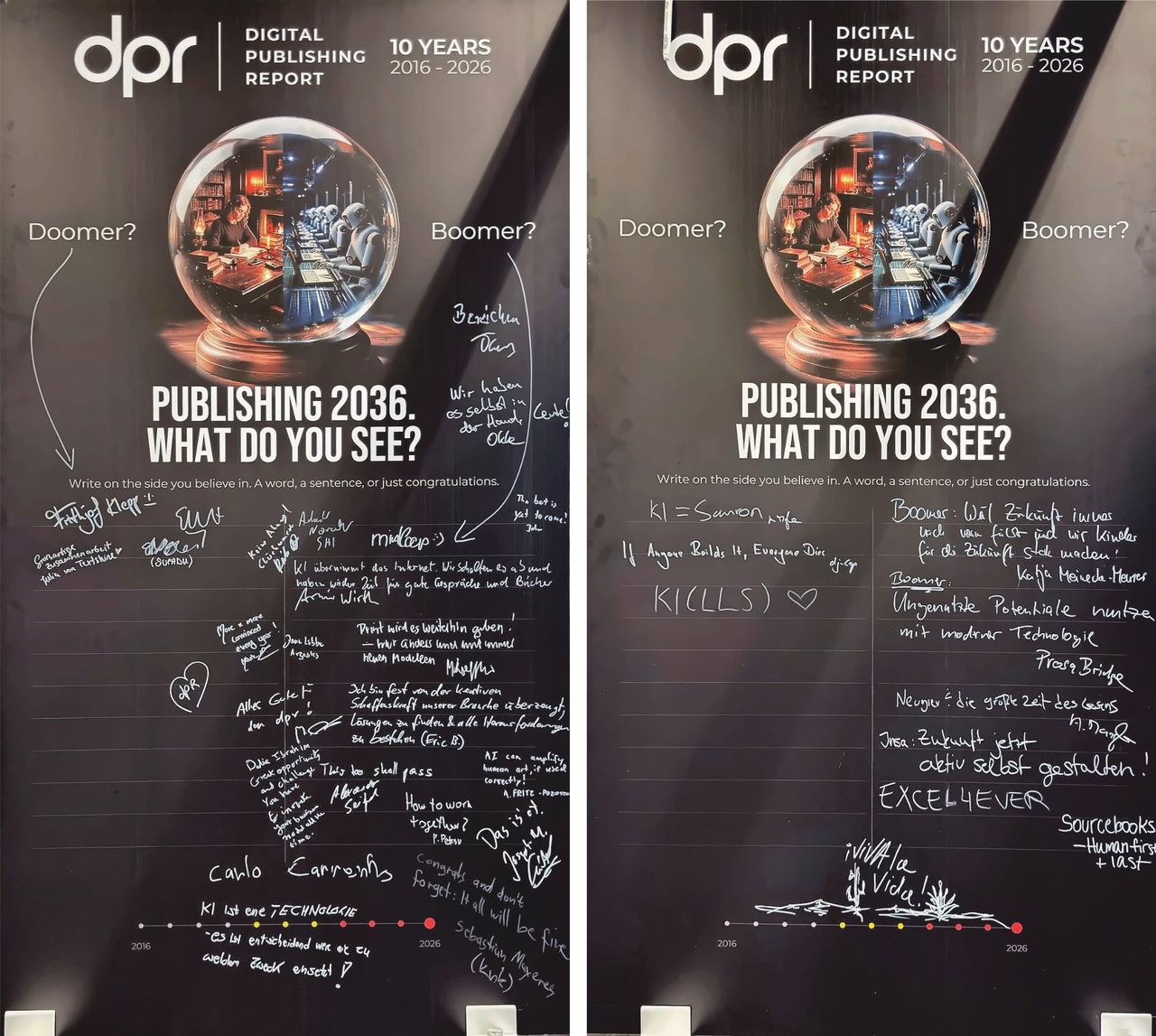
A campaign like this usually offers little in the way of substantive input – nor does it need to, as the aim is to encourage participation and, ultimately, to spark discussion. And yet, there are some interesting insights to be gleaned from the boards. What’s striking at first is the imbalance. In the middle (where almost everyone wanted to sign) and on the right, the entries are crammed right up to the edge, whilst on the left there is a surprising amount of space left – even though I had actively encouraged people to sign on the left alongside the ‘doomers’, following my own example, as I do indeed take a rather gloomy view of the future for my profession, journalism.
“If Anyone Builds It, Everyone Dies”?
There certainly are doomers: one person has written down the book title ‘If Anyone Builds It, Everyone Dies’ – the gloomiest possible interpretation of the AI debate – whilst another has simply turned ‘KI’ (German for AI) into ‘KI(LLS)’ and added a heart, which could be read as a warning, a pun, or both. On the second board, on the left, there are mainly congratulations, signatures and a heart with “dpr” inside it. The sense of doom that one might have expected after a year full of licensing disputes, revenue concerns and AI swan songs has, all things considered, failed to materialise, at least on the boards.
Turning to the right-hand side, the optimists: this attitude is by no means naïve – quite the opposite. A striking number of entries attach a condition to it. “Actively shape the future ourselves, right now!” it says. Elsewhere: “It’s in our own hands.” (Okke Schlüter, Hochschule der Medien, Stuttgart). AI is a technology, writes one person; what matters is who uses it and for what purpose. One entry in English says that AI can amplify human art – “if used correctly” (Adam Fritz from the audio service provider Pozotron). And Sourcebooks (represented by Lynn Sikora, Director of International Marketing & Publicity) has distilled this stance into three words: “Human first + last”.
“Constantly reinventing your own business model”
This is not enthusiasm for technology, but rather a demand placed on one’s own industry, most clearly articulated in a longer post: the writer is firmly convinced of the “creative power of our industry” to find solutions and overcome all challenges (Bookwire innovator Eric Bartoletti). The Egyptian publisher Dalia Ibrahim sums it up as follows: both an opportunity and a challenge – one must constantly reinvent one’s own business model. And Tessloff publisher Katja Meinecke-Meurer from Germany states that she is a Boomer because “the future always leads forward and we are making children strong for the future”.
Between the big statements stand the small ones, and they are often the best. “Print will still be around! Just in a different form and with ever-changing models,” says Matthias Koeffler, publisher of Langendorfs Dienst (Germany). One person suggests letting AI take over the internet, then switching it off so we can have time again for good conversations and books (Armin Wirth from the German e-commerce solutions provider Wirth und Horn).
One person simply writes “EXCEL4EVER”, another writes “This too shall pass”, and a third writes “That’s OK.” And stretching across the board is a message of congratulations from Sebastian Mayeres (knk), with the addition: “Don’t forget: It all will be fine.”
BTW: Right at the bottom of the board, there’s a timeline printed on it, with eleven points spanning from 2016 to 2026. The visitors have simply written over it – with sentences, names and a little drawing complete with ‘¡Viva la Vida!’. We couldn’t have heralded the next ten years any better. We’ve kept the boards and will check back in 2036 to see which side was right. My guess: both, to some extent. The future of this industry is being written right now – by hand, with felt-tip pens, and fortunately not by us alone.
And what do the boards tell us about ourselves? For the anniversary issue 10 (in German), we analysed ten years’ worth of dpr content, a good 7,000 pages: the proportion of pages in which AI is mentioned rose from 12 to 62 per cent during this period. So we’ve written a great deal about machines – perhaps more than the industry would have liked. The entries at our stand, by contrast, are strikingly often about people: about conversations, books, children and collaboration. “How to work together?”, asks Plamen Petrov, and that is perhaps the wisest question on both boards. I take this as a friendly but clear correction – and as a task for the next ten volumes.
Daniel Lenz, Editor-in-Chief of Digital Publishing Report